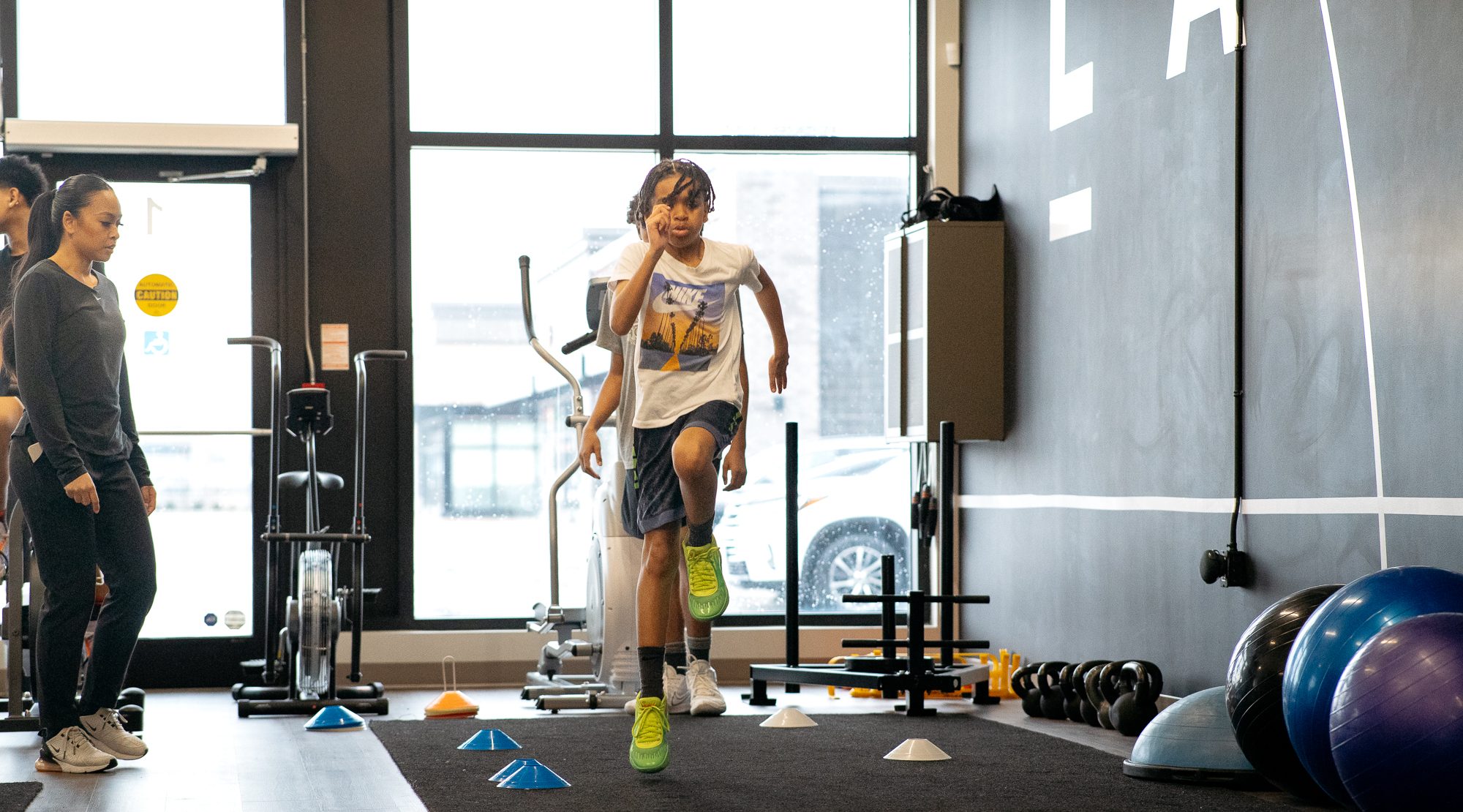
Youth sports are highly competitive in a city like Mississauga. Parents want their kids to not just win, but also to stay healthy, work smart and make the most of recruitment opportunities. We need objective metrics to track the exact, real-time progress of your athletic development, ensuring you excel without the risk of burnout or getting injured. This is where data-driven athletic training comes into play. The data reflects the efficiency of your training program and empowers you to perform at your personal best safely.
What Is Data-Driven Training For Athletes?
Data-driven training is the use of objective, quantifiable metrics to track and guide an athlete’s development. It combines Sports Science testing with advanced technology to show exactly what is happening in the athlete’s body and how we can maximize performance and deliver optimal results.
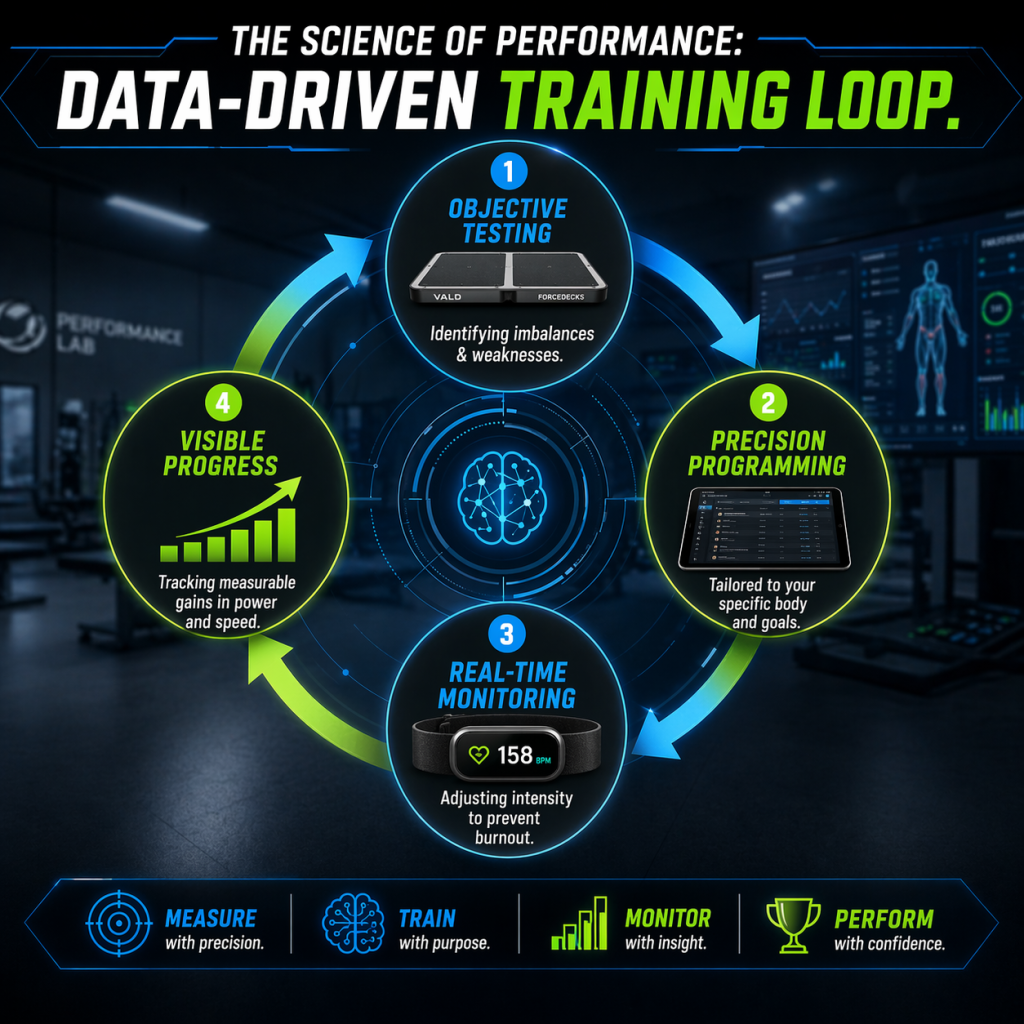
At a high-performance facility like Latitude, we use VALD performance technology to objectively measure how an athlete moves, helping us identify strength, imbalances and opportunities for improvement. . ForceDecks, for example, is a dual force plate technology that helps us measure force symmetry. If testing shows a 20% strength or force deficit in the left leg during landing, it may indicate an imbalance that is associated with an increased risk of injury..
So we identify the exact weakness and work on it before it becomes a serious injury.
Why Mississauga Parents Are Making The Switch To Data-Driven Training?
Traditional methods of training are starting to evolve with the integration of technology and data-informed programmingAbout 62% of youth sports programs already incorporate some sort of sports technology in their training program. So why is this shift towards objective data happening? Let’s find out.
Injury prevention
Sports-related injuries are the leading cause of emergency room visits for teenagers in the Peel region, including Mississauga. About 50% of all youth sports injuries fall under overuse injuries, including strains, stress fractures and tendonitis. These rising rates of injury increase the demand for high-performance training in this region.
Here is how technology provides insights that help coaches and clinicians reduce injury risk in young athletes
Identifying hidden weaknesses and imbalances
There are subtle differences in how the body moves or produces forces. For example, one leg may generate more power than the other, or some players may notice limited mobility in one joint, causing compensation elsewhere in the body. Now these imbalances put an uneven stress on muscles, tendons and joints, resulting in injuries and a performance plateau. Data-driven tools, such as Force Plates, detect these imbalances early. The trainer can then design a precise training program to correct that particular weakness.
Monitoring workload
Improper load progression during a workout is one of the biggest causes of injury among athletes. Doing too much too soon and without enough recovery can affect your health and performance big time. But sports technology allows coaches to track metrics like training volume, intensity and recovery, to understand how much stress the body is under. This data helps the coach understand the endurance capacity of an athlete during a game or practice. Accordingly, they reduce the intensity of your training to help your body recover and prevent muscle strains.
Personalization of training
No two athletes are the same. The traditional one-size-fits-all training approach doesn’t cater to the specific requirements of every athlete. Sports technology, on the other hand, allows the training to be tailored specifically to each athlete’s body, capacity and goals.
Here is how data-driven training enables personalization.
- Understanding the individual athlete– Data-driven training involves detailed tracking of the athlete’s fitness levels, recovery capacity, movement quality, limitations and injury history. Strength trainers use this data to build an accurate, precise athlete profile.
- Real-time adjustments– The trainer can modify the training program in real time based on the athlete’s endurance capacity and recovery status.
- Targeted training– Technology in sports helps trainers design targeted training programs based on the individual needs of athletes. If the data shows weak glutes, your trainer may add activation and strength work to the routine. Similarly, if limited mobility is your problem, they may prioritize corrective exercises.
A personalized training program helps build smarter, more aware athletes. You can understand how your body responds to training – when to push, when to pull back and when to rest.
Visible progress
An athlete works hard for months. But if they can’t see the progress or improvements, it can lead to frustration or self-doubt. Data-driven training, however, gives you real-time feedback on your improvement in strength, endurance or movement quality. You can clearly see where you started, where you have reached and how far you need to go.
Why is real-time data feedback important for athletes?
Motivates the athlete
Whether it’s your vertical jump height or explosive power, visible improvements in the metrics prove that you have put in the work. Gradual improvements help build confidence in athletes.
Provides peace of mind to the parents
Parents want to know if their child is training effectively. They want to know if the hours spent driving to the training facility in Brampton are actually translating into desired results. The objective data about their child’s athletic performance and fitness can show exactly how your child is improving and how their injury risk has dropped.
Data-backed training
Sports technology reduces guesswork by providing objective data that guides training decisions. Tools like VALD ForceDecks and DynaMo allow coaches to monitor how an athlete responds to specific training. Instead of relying on assumptions, coaches can track changes in force, asymmetry, and movement quality over time. If progress isn’t reflected in the data, training variables can be adjusted to better align with the athlete’s goals.
Conclusion
For parents in Mississauga, using sports technology in training is not just about turning the kid into a professional athlete. Rather, it is about embracing sports science and modern technology to ensure that the kids stay safe, show clear improvements and perform their best during training. Data-driven athletic training is the use of sports technology to keep track of and improve young athletes’ performance. Real-time data provides a clear view of training effectiveness, uncovering imbalances, guiding load management, and making progress measurable. It enables athletes to train more consistently and reduce injury risk, while giving coaches the information needed to make more informed decisions.
Latitude Performance serves as a high-performance facility for the next generation of athletes in Brampton, Milton and Mississauga. We use VALD Performance Technology to assess, monitor and guide every athlete with a personalized training program.
FAQs
What is data-driven training for athletes?
Data-driven training uses objective, quantifiable metrics combined with sports science testing and advanced technology to track and guide athlete development, helping to optimize performance and minimize injury risks.
Why are Mississauga parents switching to data-driven training for their kids?
Parents are switching because technology helps prevent injuries by identifying imbalances and monitoring workload, and it enables personalized training that leads to visible progress and increased confidence.
How does technology help in preventing sports injuries among young athletes?
Technology detects hidden weaknesses and imbalances early, monitors training loads to prevent overtraining, and allows for tailored programs that address specific needs, reducing injury risk.
How does data-driven training personalize athletic development?
It personalizes training by detailed tracking of each athlete’s fitness, movement, and injury history, enabling trainers to adjust programs in real time based on individual recovery and capacity, leading to targeted improvements.
Why is real-time feedback important during athletic training?
Real-time feedback motivates athletes by showing their progress, gives parents peace of mind by demonstrating training effectiveness, and helps coaches make data-backed adjustments to enhance performance and reduce injury risk.
References
| APA Reference |
| Econ Market Research. (2025). Youth sports market size, share and growth report. (Econ Market Research) Retrieved from https://www.econmarketresearch.com/industry-report/youth-sports-market |
| VALD Performance. (n.d.). Performance technology and athlete testing solutions. Retrieved from https://valdperformance.com/ |
| Canadian Paediatric Society. (2009). Organized sports for children and youth. Paediatrics & Child Health, 14(7), 439–443. Retrieved from https://academic.oup.com/pch/article-abstract/14/7/439/2639212 |
| Bartlett, R. (2007). Introduction to sports biomechanics: Analysing human movement patterns. Proceedings of the Institution of Mechanical Engineers, Part P: Journal of Sports Engineering and Technology. Retrieved from https://journals.sagepub.com/doi/abs/10.1243/17543371JSET4 |
| Müller, E., et al. (2023). Science and practice of strength training. Springer. Retrieved from https://link.springer.com/book/10.1007/978-3-662-68703-1 |
| Bishop, D., et al. (2018). High-performance training for sports. Springer. Retrieved from https://link.springer.com/book/10.1007/978-3-319-75046-0 |